Retain usable context for original imagery, capture date, location, or asset identification.
Visual-review preparation reference
This public page only explains how to organize context for human review. It is not a field-inspection procedure or an engineering-disposition instruction.
Record visible appearance and viewing limits; do not infer depth, rate, or integrity from a single image.
List environment, exposure, and existing measurement data as items for qualified confirmation.
Scope of methods and tools
Visual, laboratory, measurement, and professional inspection methods each have applicable conditions. This platform does not perform, instruct, or certify any test, material choice, protection method, or site action.
User-provided visual reference
Visual comparison of eight corrosion forms
This chart places visible examples of uniform, pitting, crevice, galvanic, stress-corrosion cracking, erosion corrosion, corrosion fatigue, and microbiologically influenced corrosion side by side as a guide to terminology and visible cues.
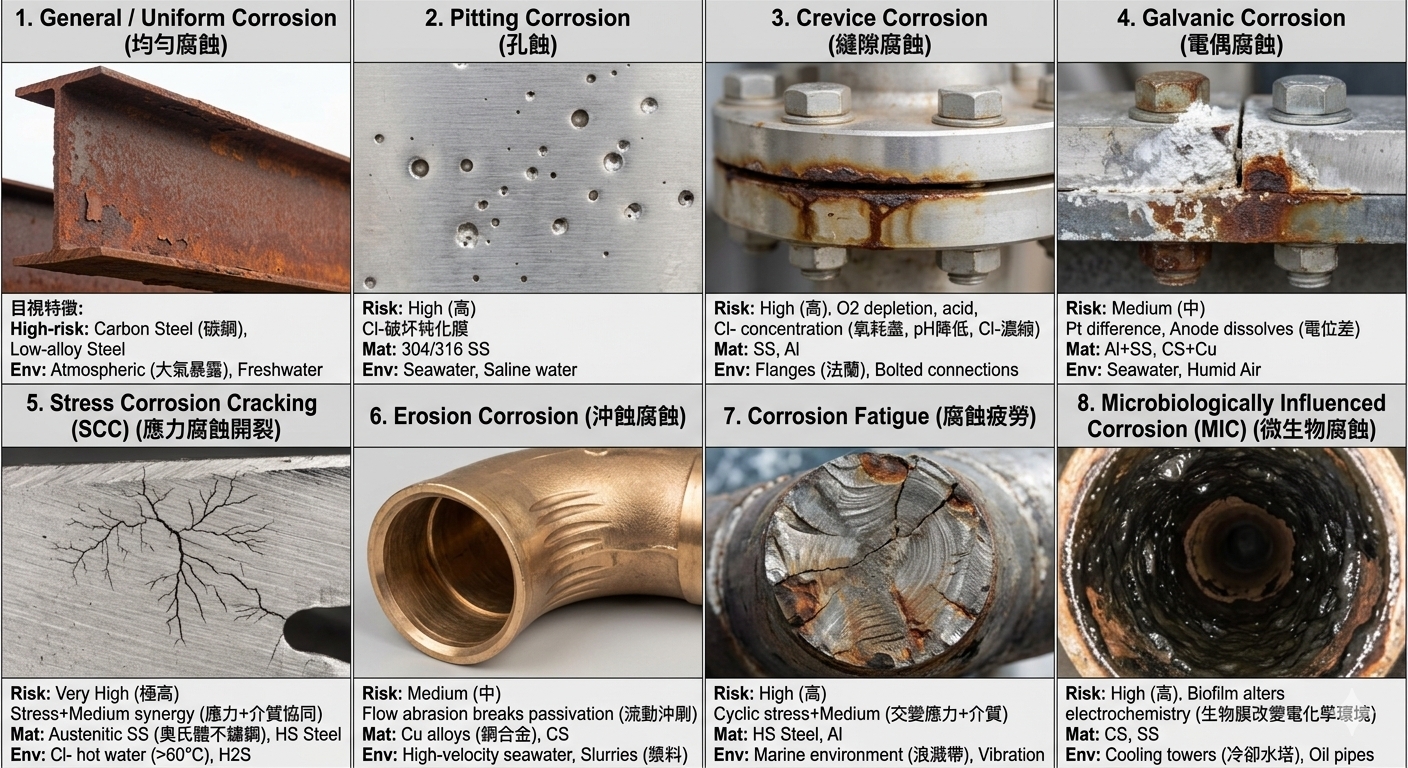
For visual triage and human-review preparation only. Do not infer an individual asset’s corrosion type, severity, material, environment, performance, life, cost, structural safety, or engineering action from the image or its labels. Final determinations require qualified personnel using field measurements, applicable standards, and owner procedures.
Text reference for eight corrosion types
Common visible cues, material context, and environments are organized as text; no corrosion images of uncertain origin are used.
Text reference
Uniform Corrosion
General / Uniform Corrosion
Causes
Uniform contact between metal surface and corrosive media (water, acid, alkali, salt) causes electrochemical reactions across the entire surface. Common in carbon steel exposed to atmosphere or aqueous solutions.
Visual Features
Surface shows uniform reddish-brown (rust) or grayish-white oxide layer, no obvious localized pits, uniform thickness reduction, rust layer may peel and flake.
High-Risk Materials
Carbon steelLow-alloy steelCast ironZincAluminum (acid/alkali)
Typical Environments
Atmospheric exposureFreshwater pipelinesAcidic solutionsIndustrial wastewater
Review-preparation reminder
These text references do not replace field measurement, method selection, or disposition decisions. Qualified personnel must confirm them under site procedures.
Text reference
Pitting Corrosion
Pitting Corrosion
Causes
Chloride ions (Cl⁻) break down the passive film at local defects, forming micro-cells. The pit interior acts as anode (active dissolution) and exterior as cathode (oxygen reduction), creating an autocatalytic acceleration mechanism.
Visual Features
Surface shows scattered small pits (0.1–5mm diameter), pit mouths may be covered by corrosion products, pit depth far exceeds diameter — appears minor but actual penetration is significant.
High-Risk Materials
Stainless steel (304/316)Aluminum alloysNickel alloysTitanium alloys (high temp)
Typical Environments
Chloride-containing seawaterSwimming pool waterFood processing brineIndustrial cooling water with Cl⁻
Review-preparation reminder
These text references do not replace field measurement, method selection, or disposition decisions. Qualified personnel must confirm them under site procedures.
Text reference
Crevice Corrosion
Crevice Corrosion
Causes
In flanges, gaskets, bolts and other joint crevices, stagnant solution depletes oxygen, lowering pH and concentrating Cl⁻ inside the crevice, creating an autocatalytic mechanism similar to pitting.
Visual Features
Corrosion concentrated at crevice edges, brown or black corrosion products seep from crevice, metal severely dissolved inside while exterior surface may appear intact.
High-Risk Materials
Stainless steelAluminum alloysTitanium alloysNickel-base alloys
Typical Environments
Seawater pipeline flangesHeat exchanger tube sheetsBolted connectionsGasket contact surfaces
Review-preparation reminder
These text references do not replace field measurement, method selection, or disposition decisions. Qualified personnel must confirm them under site procedures.
Text reference
Galvanic Corrosion
Galvanic Corrosion
Causes
Two metals with different electrochemical potentials in contact through an electrolyte cause the more negative metal (anode) to corrode acceleratedly while the more positive metal (cathode) is protected. Larger potential difference and cathode/anode area ratio worsen corrosion.
Visual Features
Accelerated corrosion near the contact area of the anodic metal, white (Al/Zn) or brown (steel) corrosion products accumulate, cathodic metal surface usually intact.
High-Risk Materials
Aluminum alloy + stainless steelCarbon steel + copper alloyZinc coating + steelMagnesium alloy + aluminum
Typical Environments
SeawaterIndustrial cooling waterHumid atmosphereBuried soil pipelines
Review-preparation reminder
These text references do not replace field measurement, method selection, or disposition decisions. Qualified personnel must confirm them under site procedures.
Text reference
Stress Corrosion Cracking
Stress Corrosion Cracking (SCC)
Causes
Tensile stress (residual or working) combined with specific corrosive media causes crack initiation and propagation in susceptible materials. Crack growth rate far exceeds pure corrosion or fatigue, leading to sudden brittle fracture.
Visual Features
Cracks show branching tree pattern (transgranular) or follow grain boundaries (intergranular), crack faces show little plastic deformation, flat fracture surface with minor corrosion products around cracks.
High-Risk Materials
Austenitic stainless steel (Cl⁻ environment)High-strength steel (H₂S environment)Brass (ammonia environment)Aluminum alloys (halogen environment)
Typical Environments
High-temp Cl⁻ water (> 60°C)H₂S acidic oil/gas environmentAmmonia/amine solutionsHigh-concentration NaOH solution
Review-preparation reminder
These text references do not replace field measurement, method selection, or disposition decisions. Qualified personnel must confirm them under site procedures.
Text reference
Erosion Corrosion
Erosion Corrosion
Causes
Flowing media (liquid, gas, slurry) mechanically removes the passive film, continuously exposing fresh metal to corrosive media. Elbows, reducers, valves and other flow-change points are most severely affected.
Visual Features
Directional corrosion along fluid flow, forming grooves, horseshoe pits or smooth depressions, streamlined wear marks on surface, metallic luster may be retained due to continuous abrasion.
High-Risk Materials
Copper alloys (seawater pipelines)Carbon steel (slurry pipelines)Cast ironSoft aluminum alloys
Typical Environments
High-velocity seawater pipelinesSlurry with solid particlesSteam pipelines (droplet impact)Pump impellers/propellers
Review-preparation reminder
These text references do not replace field measurement, method selection, or disposition decisions. Qualified personnel must confirm them under site procedures.
Text reference
Corrosion Fatigue
Corrosion Fatigue
Causes
Alternating stress (cyclic loading) combined with corrosive media lowers fatigue crack initiation threshold and accelerates propagation. Unlike pure fatigue, corrosion fatigue has no clear fatigue limit — any stress amplitude in a corrosive environment can cause failure.
Visual Features
Cracks typically initiate from surface corrosion pits or defects, multiple parallel or radial cracks, fracture surface shows beach marks (fatigue striations) mixed with corrosion products, crack path straighter than SCC.
High-Risk Materials
High-strength steel (offshore platforms)Aluminum alloys (aviation/marine)Stainless steel (chemical equipment)Titanium alloys (seawater)
Typical Environments
Marine environment (splash zone)Cl⁻-containing cooling waterAcidic oil/gas environmentVibrating pipelines
Review-preparation reminder
These text references do not replace field measurement, method selection, or disposition decisions. Qualified personnel must confirm them under site procedures.
Text reference
Microbiologically Influenced Corrosion
Microbiologically Influenced Corrosion (MIC)
Causes
Sulfate-reducing bacteria (SRB), iron-oxidizing bacteria (IOB), sulfur-oxidizing bacteria and other microorganisms form biofilms on metal surfaces, altering local electrochemical environment and producing corrosive metabolites such as H₂S and organic acids.
Visual Features
Black or brown sticky biofilm on surface, irregular deep pits after removal (larger and more irregular than pitting), sometimes accompanied by sulfide odor, black FeS deposits may be found at pit bottoms.
High-Risk Materials
Carbon steelStainless steel (low-flow dead zones)Copper alloysConcrete structures
Typical Environments
Industrial cooling towersOil pipelines (dead-water sections)Wastewater treatment facilitiesSubsea pipelines
Review-preparation reminder
These text references do not replace field measurement, method selection, or disposition decisions. Qualified personnel must confirm them under site procedures.
ISO 9223 Atmospheric Corrosivity Classification
Six corrosivity categories from C1 to CX based on atmospheric environment
C1Very Low
Indoor dry environments: offices, schools, museums
Typical Environment:Office building interiors
Carbon-steel first-year thickness-loss reference:≤ 1.3 μm/yr
C2Low
Low-pollution rural atmosphere, occasional condensation
Typical Environment:Rural buildings, warehouses
Carbon-steel first-year thickness-loss reference:> 1.3–25 μm/yr
C3Medium
Urban or industrial atmosphere, moderate SO₂ pollution
Typical Environment:Urban buildings, factories
Carbon-steel first-year thickness-loss reference:> 25–50 μm/yr
C4High
High-pollution industrial or coastal areas
Typical Environment:Chemical plants, coastal buildings
Carbon-steel first-year thickness-loss reference:> 50–80 μm/yr
C5Very High
High-humidity industrial or marine atmosphere
Typical Environment:Shipyards, offshore platforms
Carbon-steel first-year thickness-loss reference:> 80–200 μm/yr
CXExtreme
Marine or extreme industrial environment (< 1km from coast)
Typical Environment:Offshore drilling platforms, port facilities
Carbon-steel first-year thickness-loss reference:> 200–700 μm/yr
Governed visual and environment reference
Visible cues and environment data: organize separately, review by people
Visible cues in an image and ISO 9223 atmospheric-corrosivity data are different information sources. A photograph cannot derive one from the other or create an engineering conclusion.
Read the M × C × L → Ri Review MatrixWhat imagery can organize
It can organize appearance, capture location, time, and visibility limits as material for human review.
Role of environment data
ISO 9223 is an atmospheric-corrosivity reference. Environmental classification requires applicable exposure and measurement data.
The matrix on this page is only a review-priority and record-organization reference. It is not a material-condition, structural-safety, ISO-conformity, life, cost, or disposition conclusion.
Interactive Matrix
L × C Review-Preparation Reference
Select a visible-cue row to view record-organization and human-review priority; no method, repair, shutdown, or safety instruction is provided.
Routine reviewComplete evidencePriority reviewUrgent review
Select a row to view review-preparation guidance
This matrix only supports organization of human-review priority. It is not a corrosion classification, environmental classification, engineering, safety, or disposition conclusion.
| Visible cue / environment reference | C1 | C2 | C3 | C4 | C5 | CX |
|---|---|---|---|---|---|---|
| L0No clear visible cue | Routine review | Routine review | Complete evidence | Complete evidence | Priority review | Priority review |
| L1Minor visible change | Routine review | Routine review | Complete evidence | Priority review | Priority review | Urgent review |
| L2Visible change | Routine review | Complete evidence | Complete evidence | Priority review | Urgent review | Urgent review |
| L3Pronounced visible change | Complete evidence | Complete evidence | Priority review | Urgent review | Urgent review | Urgent review |
| L4Severe visible change | Complete evidence | Priority review | Urgent review | Urgent review | Urgent review | Urgent review |
| L5Material cue requiring human confirmation | Priority review | Urgent review | Urgent review | Urgent review | Urgent review | Urgent review |